
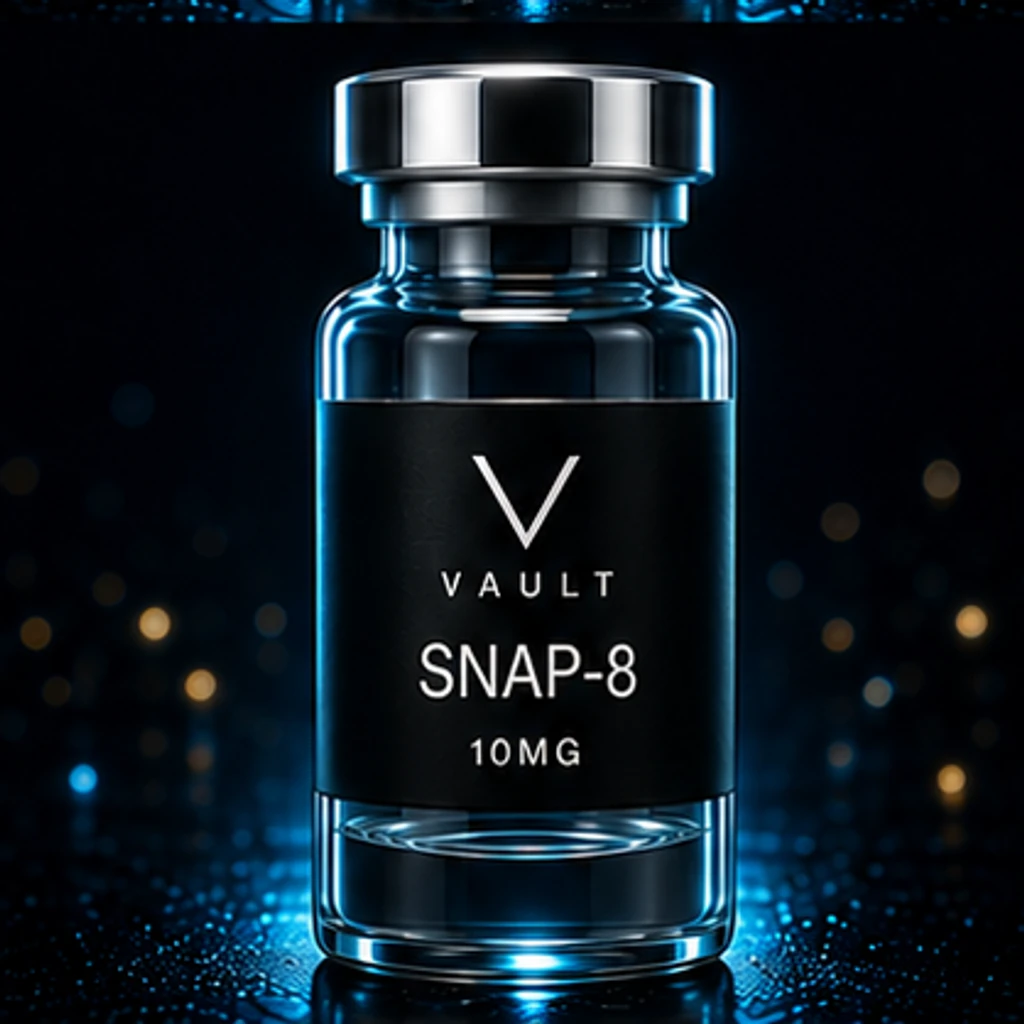
Cosmetic Peptide
SNAP-8
Independently lab-verified acetyl octapeptide-3, HPLC & LC-MS tested.
Strength
₱1,750.00 PHP
100 units in stock · SKU SNAP8-10
Independently lab-verified. HPLC & LC-MS tested. Ships nationwide across the Philippines.
Product information
Research summary
SNAP-8 is an octapeptide — acetyl glutamyl heptapeptide-3 — designed as an extended analogue of Argireline, elongated by two residues. Both are derived from the N-terminal sequence of SNAP-25, a component of the SNARE complex that mediates vesicle fusion at the synapse. The mechanistic premise is competitive interference with SNARE complex assembly. SNAP-25 must associate with syntaxin and VAMP to form the fusion machinery that releases acetylcholine at the neuromuscular junction; a peptide mimicking the relevant SNAP-25 segment can compete for incorporation into that complex, destabilising it. Published in-vitro work examines the peptide's effect on catecholamine and neurotransmitter release in cell models, and comparative studies assess whether the two additional residues confer greater competitive affinity than the shorter hexapeptide. It is studied principally in cosmetic and dermal formulation research. Purity is confirmed by RP-HPLC and identity by LC-MS, with batch-linked data published for every lot.
Handling & reconstitution
Supplied lyophilised. Allow the vial to reach room temperature before opening. Reconstitute with sterile or bacteriostatic water added down the inner wall. SNAP-8 is highly water-soluble owing to its acidic sequence and dissolves within seconds under gentle swirling. For formulation work, note that the peptide is acidic and its solubility and stability are pH-dependent — buffer the working preparation rather than relying on the peptide solution alone, and add it late in a formulation sequence to limit exposure to processing conditions.
Storage
Lyophilised: -20 °C, sealed and dry. The acetylated N-terminus improves stability relative to a free-amine peptide. Reconstituted: 2–8 °C, used within approximately four weeks. There are no oxidation-prone residues in the sequence, so the peptide is chemically stable in neutral aqueous solution; microbial contamination is the realistic spoilage route, and sterile technique addresses it. Avoid strongly alkaline conditions and freeze-thaw cycling.
Reviews
No reviews yet.