
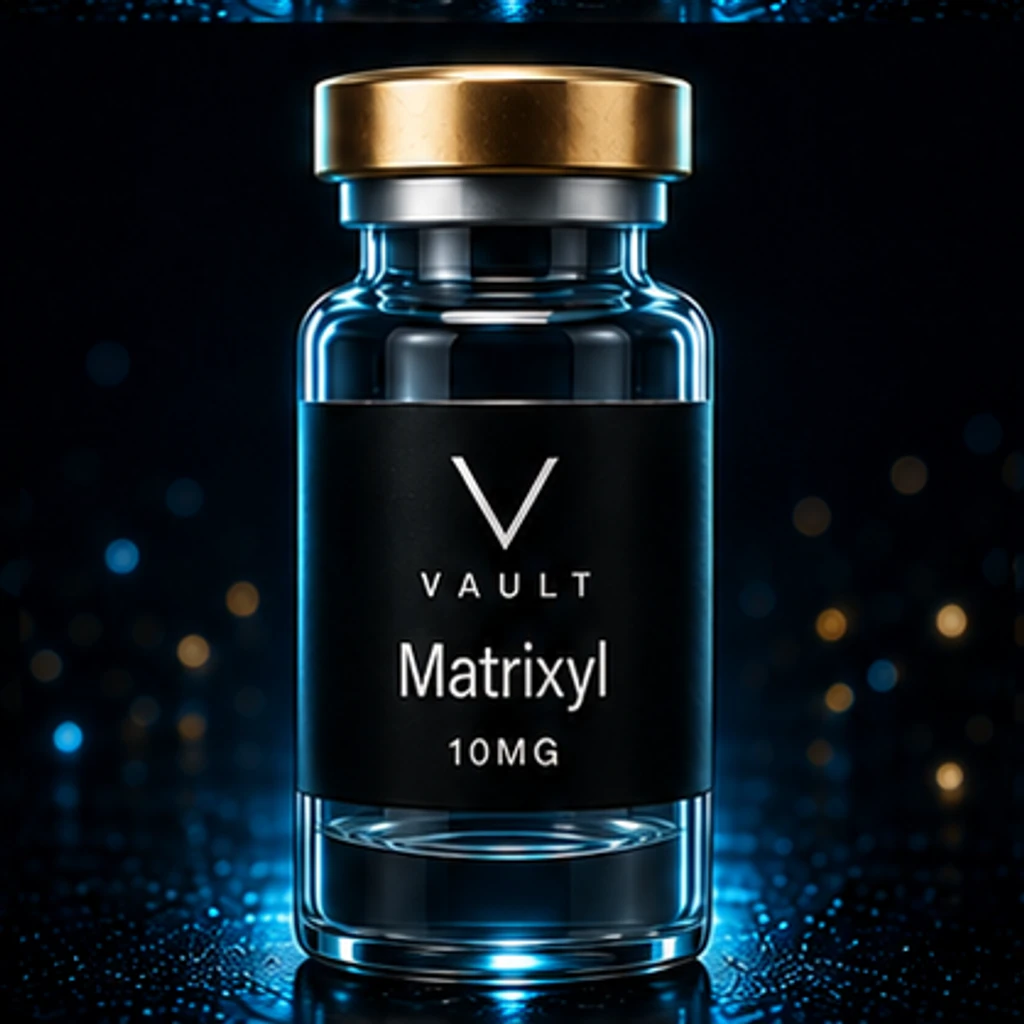
Cosmetic Peptide
Matrixyl
Independently lab-verified palmitoyl pentapeptide-4, HPLC & LC-MS tested.
Strength
₱1,850.00 PHP
100 units in stock · SKU MTRX-10
Independently lab-verified. HPLC & LC-MS tested. Ships nationwide across the Philippines.
Product information
Research summary
Matrixyl is palmitoyl pentapeptide-4 — the sequence Lys-Thr-Thr-Lys-Ser conjugated to palmitic acid. The peptide portion is a subfragment of the C-terminal propeptide of type I procollagen, a fragment released during collagen maturation that acts as a feedback signal to fibroblasts. The palmitoyl chain is a delivery modification rather than a biological one: the bare pentapeptide is hydrophilic and penetrates lipid membranes poorly, and lipidation is what makes it able to cross the stratum corneum in dermal research models. Published in-vitro work on fibroblast culture describes stimulation of extracellular matrix synthesis — type I and type III collagen, fibronectin and glycosaminoglycans — consistent with the fragment acting as a signal that collagen turnover is occurring. It is one of the most widely studied peptides in dermal formulation research and appears frequently as a comparator for newer matrix-signalling peptides. Each lot is analysed by RP-HPLC and verified by LC-MS, with batch-specific data published for every release.
Handling & reconstitution
Matrixyl is lipidated and does not dissolve like the water-soluble peptides in this catalogue. The palmitoyl chain makes it amphiphilic: it disperses rather than dissolving cleanly in water alone, and it foams readily when agitated. Common practice is to wet the powder with a small volume of a water-miscible co-solvent such as propylene glycol or glycerol before bringing it to volume with the aqueous phase, which gives a clearer preparation than water alone. Add liquid slowly, swirl gently, and expect a minute or two for full dispersion. Do not shake — the surfactant-like behaviour of the lipid chain will produce persistent foam.
Storage
Lyophilised: -20 °C, sealed, dry and protected from light. The palmitoyl chain is subject to slow oxidation over long periods, so keeping the vial sealed and cold matters more than for an unmodified short peptide. Reconstituted or dispersed: 2–8 °C, used within approximately four weeks. Lipidated peptides tend to aggregate at the air-liquid interface over time; inspect for separation or surface film before use and re-disperse gently rather than shaking. Avoid freeze-thaw cycling, which drives irreversible aggregation of the lipid portion.
Reviews
No reviews yet.