
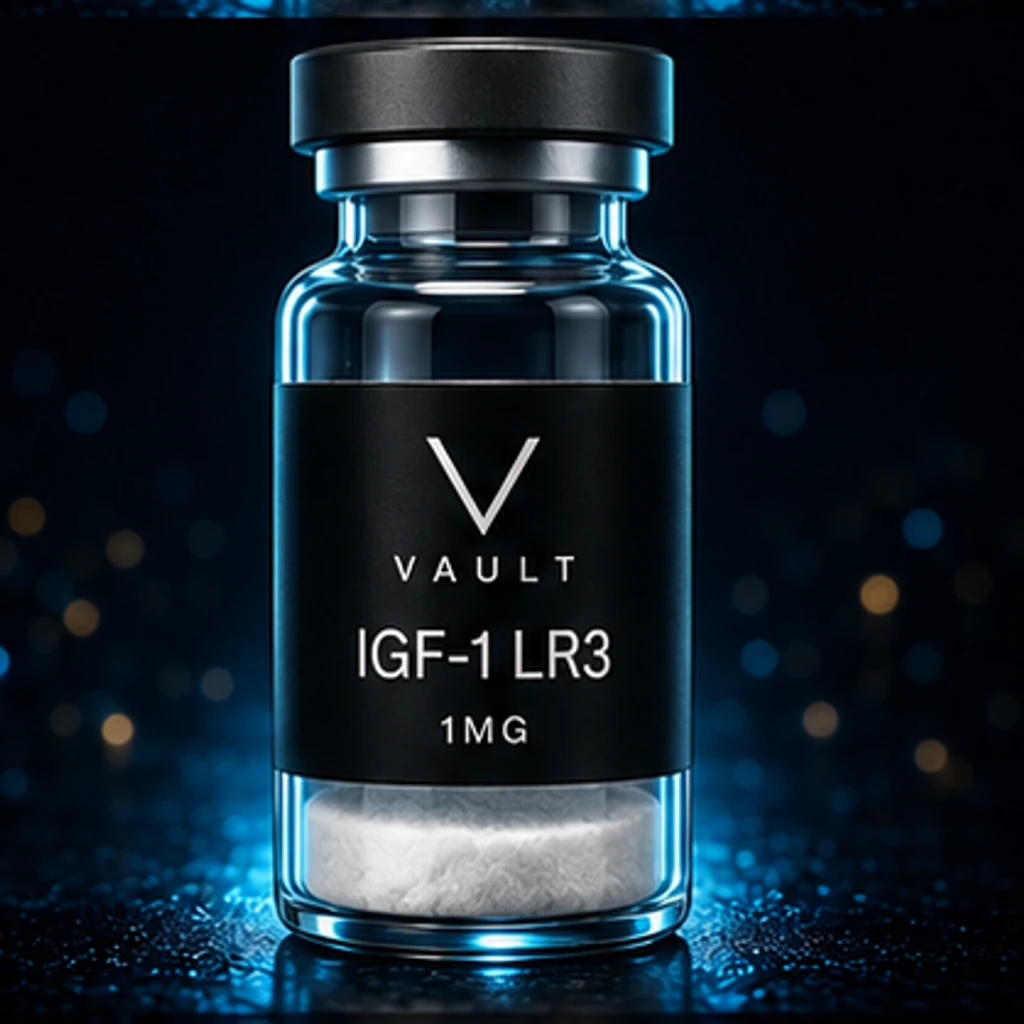
IGF Analogue
IGF-1 LR3
Independently lab-verified long-arginine IGF-1 analogue, HPLC & LC-MS tested.
Strength
₱4,500.00 PHP
100 units in stock · SKU IGF1LR3-1
Independently lab-verified. HPLC & LC-MS tested. Ships nationwide across the Philippines.
Product information
Research summary
IGF-1 LR3 is an 83-amino-acid analogue of insulin-like growth factor 1, modified in two ways: an arginine substitution for glutamic acid at position 3, and a 13-residue extension at the N-terminus. Both modifications serve one purpose — drastically reducing affinity for the IGF-binding proteins that normally sequester circulating IGF-1. Native IGF-1 is almost entirely bound to IGFBPs, principally IGFBP-3, which controls its availability and clearance. By escaping that regulation, LR3 remains free in solution far longer and is correspondingly more potent in cell culture at equivalent concentrations. That property makes it a standard supplement in serum-free media formulations and a common tool in research on IGF-1 receptor signalling, PI3K/Akt activation and myoblast proliferation, where controlled and predictable growth factor availability is required. Purity is determined by RP-HPLC and identity confirmed by LC-MS, with batch-linked data published for every lot.
Handling & reconstitution
This one does not behave like the short peptides in the catalogue and should not be handled like them. IGF-1 LR3 is a folded 83-residue protein whose solubility is poor at neutral pH. It is conventionally reconstituted in dilute acetic acid — commonly 0.1 M — rather than bacteriostatic water, and then diluted into the working buffer immediately before use. Reconstituting directly into neutral aqueous diluent risks incomplete dissolution and precipitation. Add the diluent slowly, swirl gently, and allow several minutes for full dissolution. Never vortex: mechanical agitation denatures the tertiary structure that the molecule's activity depends on.
Storage
Lyophilised: -20 °C, sealed and dry, protected from light. The dry protein is stable; the folded solution is not. Reconstituted: 2–8 °C for short-term work only, ideally within one to two weeks. For anything longer, aliquot into single-use volumes and store at -20 °C or below — but freeze once only. Freeze-thaw cycling is more damaging to IGF-1 LR3 than to any short peptide here, and each cycle costs measurable activity. Carrier protein is often added to dilute working solutions to limit adsorptive loss to tube walls.
Reviews
No reviews yet.