
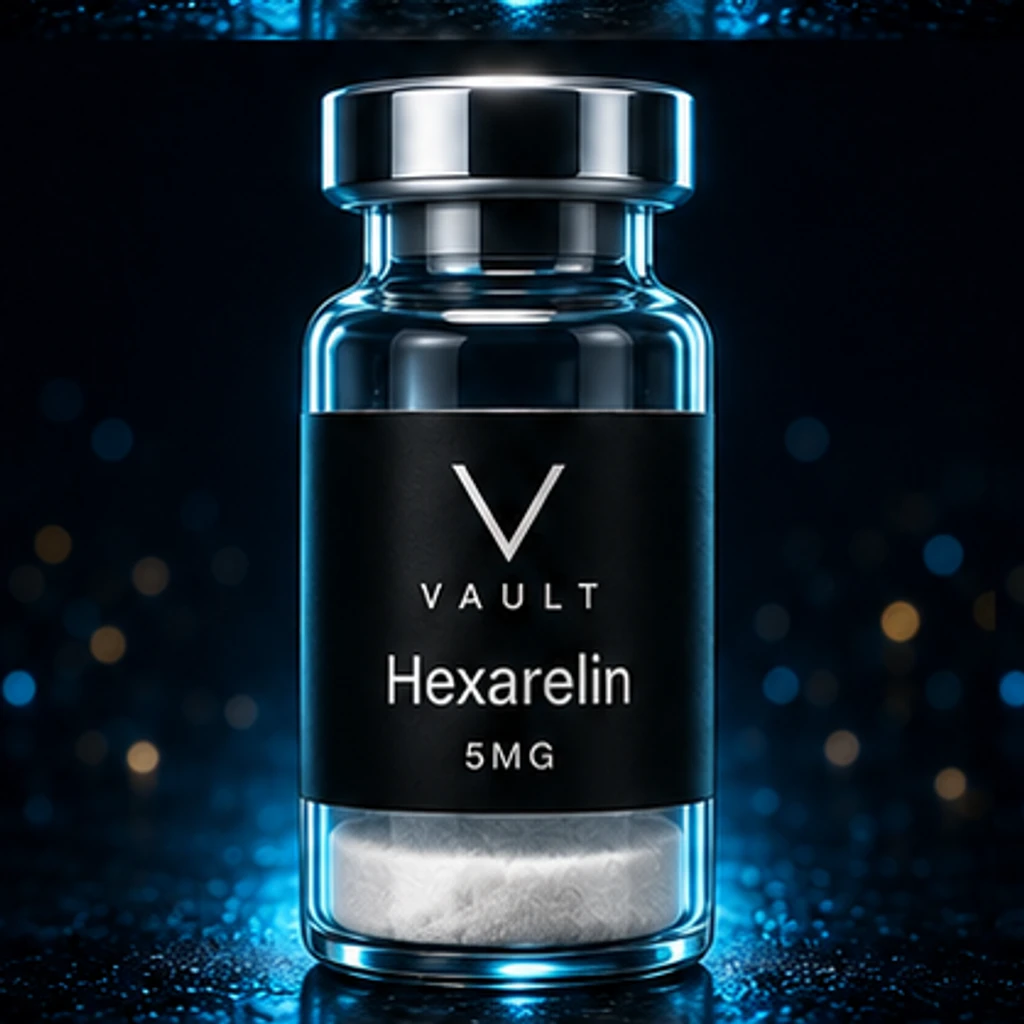
GH Secretagogue
Hexarelin
Independently lab-verified GH secretagogue, HPLC & LC-MS tested.
Strength
₱1,950.00 PHP
100 units in stock · SKU HEXA-5
Independently lab-verified. HPLC & LC-MS tested. Ships nationwide across the Philippines.
Product information
Research summary
Hexarelin is a synthetic hexapeptide growth hormone-releasing peptide — His-D-2-Me-Trp-Ala-Trp-D-Phe-Lys-NH2 — and the most potent GHS-R1a agonist of the classical GHRP series. The 2-methyl modification on the D-tryptophan residue distinguishes it from GHRP-6 and accounts for much of its increased potency and metabolic stability. Its research profile is defined by a second property: hexarelin binds CD36, a scavenger receptor expressed in cardiac tissue, independently of GHS-R1a. That dual receptor activity generated a distinct line of cardiovascular investigation, and much of the published literature examines its actions in cardiac models rather than its growth hormone effects. Studies also document pituitary desensitisation under sustained exposure, making it a useful tool for investigating receptor downregulation kinetics. Purity is confirmed by RP-HPLC and identity by LC-MS, with a batch-linked Certificate of Analysis for every lot.
Handling & reconstitution
Supplied lyophilised. Allow the vial to reach room temperature before opening. Reconstitute with bacteriostatic water added down the vial wall. Hexarelin dissolves readily with gentle swirling. Note that it contains two tryptophan residues, which are the most light-sensitive of the standard amino acids — keep the vial shielded from direct light during handling rather than leaving it out on an illuminated bench. Expect a clear solution.
Storage
Lyophilised: -20 °C, sealed and dry, in the dark. Light protection is more important for hexarelin than for most short peptides because of its tryptophan content. Reconstituted: 2–8 °C, used within approximately four weeks, stored in an opaque container or wrapped vial. Photo-oxidation of the tryptophan residues is the main degradation route in solution, and it proceeds under ordinary room lighting.
Reviews
No reviews yet.